
Building Strength that Lasts a Lifetime: Why Reformer Pilates Supports Healthy Ageing
By Dr Holly Dobbyn, Osteopathy & Pilates Studio Lead, Eureka Health
Most of the people who come into our Reformer studio for the first time after 60 aren't chasing a six-pack. They want to get up off the floor without using their hands. They want to carry the shopping in from the car in one trip. They want to trust their body on uneven ground without a flicker of doubt.
That's the version of fitness that actually matters as we age — and it happens to be exactly what the exercise research points to.
What the evidence says works
The exercise programs used internationally for hip and knee osteoarthritis, osteopenia and osteoporosis, and falls prevention all lean on the same handful of ingredients: strength training, balance work, weight-bearing load, functional movement, and progressive resistance. None of it is exotic. It's consistent, it's well studied, and it works.
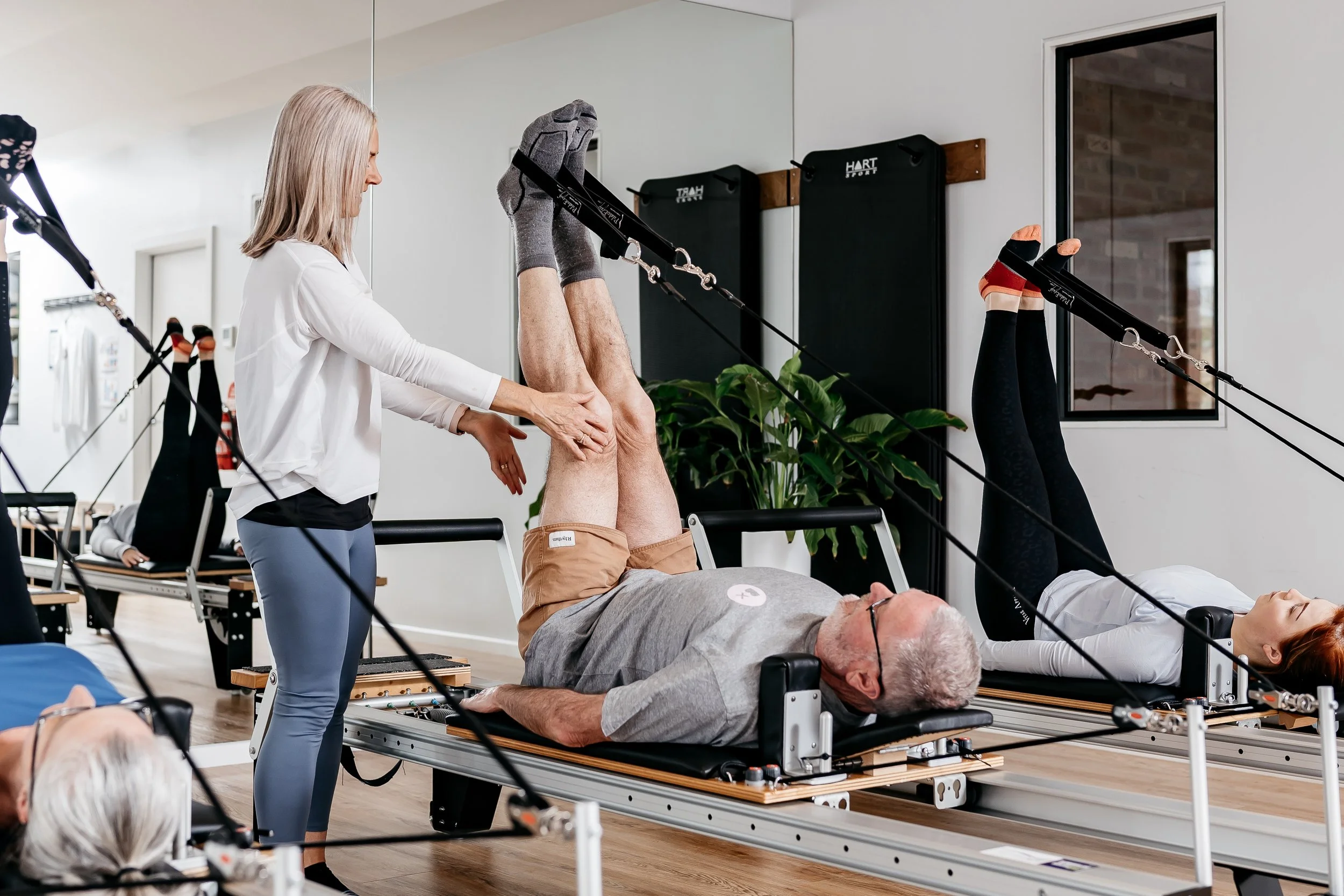
At Eureka Health, our Reformer Pilates classes are built around these same principles — delivered in small, often clinician-led groups where a physiotherapist or exercise physiologist can see how you move and adjust the exercise to suit you, not the other way around.
Building strength where it counts
We spend a lot of class time on the legs — footwork, lunges, sit-to-stands, step-ups, single-leg work. It's not about the exercise itself; it's what that strength buys you afterwards: steadier stairs, easier chairs, more confidence walking through a crowded car park.
Training balance on purpose
Around one in four Australians aged over 65 has at least one fall a year, and falls are the leading cause of injury-related hospital admissions in that age group (AIHW, 2022). The encouraging part of that research is what comes next: exercise of any kind has been shown to cut the risk of falling by roughly 23% (Australian Commission on Safety and Quality in Health Care). Balance isn't something you either have or don't — it's trainable, and we build it into class deliberately, in a supervised setting where it's safe to be challenged.
Loading your bones, not just your muscles
Bone responds to load, the same way muscle does. Our classes include progressive strengthening work that puts healthy, graded stress through the muscles and skeleton — the kind of stimulus associated with supporting bone health, alongside the muscle strength and posture benefits that come with it.
Keeping arthritic joints moving
If you live with arthritis, movement — the right kind, at the right dose — is one of the more useful tools available, and current research supports appropriately dosed exercise as part of managing pain, stiffness and loss of function. That's the instinct we work against in class: rather than avoiding movement out of caution, we help you find the range that's safe for your joints on the day, and build from there.
Strengthening the core, properly
Core strength isn't really about visible abdominal muscles — it's the quiet work that supports posture, balance, everyday lifting, and how efficiently you walk. Reformer work trains it as part of every exercise, not as an isolated add-on at the end of class.
Training for real life
Every exercise we choose has a reason behind it. A lot of what looks like "just an exercise" is actually a rehearsal for something you do most days: standing up, climbing stairs, getting off the floor, carrying shopping, reaching overhead. That's the point — the class should make ordinary life easier, not just the hour on the Reformer.
Why we keep classes small
Our sessions are deliberately small and feel different to a large fitness class. That's what allows your instructor to actually get to know you, watch your technique closely, modify exercises around injuries or medical conditions, progress you safely as you get stronger, and give you feedback that's specific to your body.
What the Reformer adds that a standard gym program doesn't
Traditional strength programs are effective, but the Reformer gives us a few extra tools. Springs allow us to load muscles through a full range of movement, build flexibility and strength at the same time, target postural muscles specifically, challenge balance in a controlled way, and train coordination alongside whole-body strength. It's still strength training — it just comes with more mobility, control and body awareness built in.
Where to start
If you're already active and want to add strength and balance training with expert eyes on your technique, you can book straight into a Reformer Pilates class. If you're managing a diagnosed condition, recovering from an injury, or simply not sure where you'd fit in, start with an initial assessment — one of our physiotherapists or exercise physiologists will look at what you need and build a plan around it before you step onto the Reformer.
Either way, we're here to help you move well for life.
[Book a Reformer Pilates class] · [Book an initial assessment]
This article is for general education only and is not a substitute for personalised medical advice. If you have a specific health condition, speak with your GP or one of our practitioners before starting a new exercise program.